Showing posts with label artist focus. Show all posts

Monday, August 7, 2017

[Repost] Artist notes: Blotch

I've skipped a few updates as I've been much busier than expected with preparations for Eurofurence 2017 - sorry about that, I'm already writing the next few entries so the blog will update regularly while I'm off to the convention. Meanwhile a fan who wishes to remain anonymous has provided me some interesting hard data regarding an old entry on my other blog, and since the entry sits well with the topic of this blog I'm reposting it here with an update.


"Blotch" is the pseudonym used by anthro artists Kenket (Tess Garman) and BlackTeagan (Teagan Gavet) during their very fruitful collaboration period which ran from 2006 to 2014. As a general rule BlackTeagan was responsible for the linework and Kenket for the coloring which was usually watercolors. Kenket has since become an extremely skilled painter while BlackTeagan is focusing on comics and ink drawing.

For simplicity I will refer to Blotch as a male since that's the gender of the fictional character they established as the author of the pictures, a male anthro leopard.

Even though the two artists already had some visibility on their own, Blotch appeared on the furry fandom scene out of nowhere and quickly rose to become one of the most popular furry artists of the late 2000s and early 2010s, if not the most popular. This led to quite a lot of controversy as he was the first highly skilled artist to feature anatomically correct genitals on characters - and quite prominently so.

Big Bad Wolf, 2008

If this had been only a distasteful gimmick it would have died out quickly. Porn sells, but not consistently and certainly not for the price tags which have been consistently associated with Blotch's art. In spite of silly internet myths there is only so much that impulse buying can do.

Blotch's art has been dismissed as mere porn by some anthro fans unwilling to admit that erotic artwork could be a credit to the genre, but it has other qualities which make it stand out as iconic anthro art, well worth of being presented as one of the most important achievements in our little genre.

Speaking of Love, 2010

Blotch's erotic art in particular could come across as kitschy because of its open sentimentality, but I would argue that that's a superficial impression and that the novelty of what it tries to express about same-sex relationships experienced by young people is more important than such academic criticism.

Does sex in art need to feel problematic, failed, overwhelmingly physical and/or openly political all the time? One would think so looking at the works of recognized masters of erotic art. I'll be using male gay artists as an example here just because Blotch's subjects are mostly male-on-male love scenes, but the situation is pretty much the same for all flavors of erotic art. There are notable exceptions like Tom Bianchi or Charles Demuth, but in most cases, from Tom of Finland to Gengoroh Tagame, from Robert Mapplethorpe to Harry Bush, power relationships are the most common underlying theme. Dominance, submission and hardcore physical sensations seem to dominate, and so does (in Western artists at least) a visual language which acknowledges and openly encourages political readings.

On the other end of the erotic gay art spectrum yaoi art leans towards more romantic tones, but power relationships are still a very prominent theme. My impression has always been that same-sex relationships are inexorably associated with unease and power struggles in contemporary art, even if only in the imagination, whether the art in question is aimed to a male, female, gay or straight audience.

And yet Blotch's art has seduced the furry audience by focusing on something else entirely: playfulness and day to day affection.

5 More Minutes, 2008

In spite of their idealized settings the best works of Blotch are gay slice-of-life art, and not of the absurdly contrived kind brought forward by some other furry artists. It is slice-of-life in that it attempts to capture ordinary moments of affection. Any couple of lovers with an open mind and an appreciation for animals and nature can't help but smile in front of the simple and yet hard to express truths found in those images.

Don't Stop, 2014

One has to look at Far East art from centuries ago such as Ukiyo-e or Indian sacred art in order to consistently find similar light-hearted portrayals of male-on-male sexuality.

Surge, 2011

This, I believe, is why Blotch's pictures have reached iconic status in furry art even though most of them depict unnamed characters rather than specific fursonas as is usually the case in the commission dominated furry art market. Such pictures clearly answered a need for representation that a huge number of furries shared. Sentimentality is not a flaw if it's brought out where it had been unjustly excluded and underestimated before.

And again, genuinely positive depictions of sex in art are so rare that they certainly cannot be considered a stale subject.

Minimum Security Prison, 2011

In dog we thrust, 2007

Penis party, 2013

Even Blotch's more whimsical pieces are full of the same playfulness and positivity which are the hallmark of good erotic anthro art. Whatever the subject an observer always gets the feeling that the characters are having a great time no matter their exact relationship to each other (or lack thereof), and that sincere feelings are never entirely absent from the sexual act.

Will this kind of art ever be recognized as the achievement it is outside of the anthro art niche? It's hard to tell, because even inside its niche there are people who would never take erotic art at more than face value. But I really hope it will, because what anthro artists like Blotch have done really is new and interesting in the landscape of Western art.


The new data that has been brought to my attention was gathered to test my statement that Blotch was the first highly skilled furry artist to regularly draw characters with animal penises. Quoting the author:
To that end I've queried the amount of images with anthro characters with and without anatomically correct genitals from e621 by year using the following tag queries: "anthro -feral 2000" and so on until 2017 for the totals, and "anthro -feral animal_genitalia 2000" and so on to calculate the percentage of anatomically correct image, and then graphed the result.

The graph turned out to be very noisy, so in order to reduce noise and better match the nature of Blotch's images I've tried again with queries "anthro -feral penis 2000" for the totals and then "anthro -feral animal_penis 2000" and "anthro -feral humanoid_penis 2000" to get the percentages, plus variants with "-blotch" appended to exclude potential skew from large amount of pictures by Blotch.

The results are very interesting: up until 2006 tag "animal_penis" makes up for at about 10% of images with "penis", in 2007-2008 Blotch single-handedly accounts for 1% of all images with "penis" on e621, and starting with 2009 the use of "animal_penis" tag skyrockets and almost doubles over the course of two years, where it remains until now with some statistical noise.

I have attached the LibreOffice spreadsheet "blotch_hypothesis" to this email so you can inspect the graphs for yourself.

It is hard to tell what social dynamics this shift corresponds to; this could be more artists adopting the realistic anatomy, or the public opinion on it shifting so that people started uploading more of such images to e621, or something else entirely. Galleries like FA would be a more reliable source, but sadly they lack a unified tag structure which makes such queries are impossible, and FA doesn't provide even basic statistics as far as I can tell.

To put the 1% figure in perspective I've also graphed the amount of explicit images on e621 by creation year, with breakdown by body type (anthro/feral/both) using queries like "anthro -feral rating:e 2000", and the results were quite unexpected to me: 2010 is when the amount of explicit art starts increasing exponentially. In fact, e621 lists as many images created in 2013 as all of the years from 2000 to 2010 combined. After 2013 it seems to taper off and exhibit linear but still rapid growth. The data and graphs can be found in the attached "anthro_feral_totals" file.


Given that Blotch took 2-3 years to reach the peak of his popularity I think the data is consistent enough with my hypothesis that Blotch first popularized anthros with animal penises, albeit that was based just on personal observation of the fandom's trends and dynamics. Up until four or five years ago it was relatively easy to tell who the handful most influential furry artists were and how much they were influencing the scene. I used to draw animal genitalia on anthros myself in some istances, like in my weird comics from 2002-2005, but all other instances I had seen came from other experimenting low profile artists like myself or from zoophile artists.

Blotch was the first to dare venturing into that territory while developing a "furry mainstream" style which was guaranteed to appeal to most of the fandom. I'm convinced that it was an intentional and carefully planned move they made in order to create a new trend with which their art would be promptly associated and which was guaranteed to cause a sensation - they saw that a good deal of the fandom was fascinated with the idea of exotic genitals but was too afraid of bestiality allegations to openly admit it. With the work of one of the topmost furry artists backing their curiosity though it quickly became a non-issue for most fans.

Another factor which contributed to the popularity of animal genitals from 2009 onward was certainly the founding of the highly successful Bad Dragon sex toys company in 2008, yet I'm quite convinced that the striking success of Blotch was a premise to the whole trend.

Thursday, June 22, 2017

Yerf finds #2 - Tracy Butler’s early art

Besides of Ailah the other artist who immediately comes to my mind when I think of Yerf is Tracy Butler, whose style and works at the time were in fact much more representative of the site’s general artistic goals. Butler later went on to a professional career as the creator of the successful comic series Lackadaisy. As of today she no longer considers herself a furry artist, which might look odd since the characters of her comics are anthropomorphic animals, but in fact I agree with her statement. I’ll get to that. Let’s start from the beginning.


Most prominent among Butler’s old art is a series of fantasy pictures showing characters and disjointed scenes from an epic fantasy setting. They are too sparse to make any guess about the general plot but there is a variety of easily recognized character types: a young doubt-stricken fox soldier, a goofy rogue-ish dog also enlisted as a soldier, a sassy rogue cat girl, an authoritarian tiger noble, a rebellious bunny concubine, and several others.

The drawings do display a budding sense of composition and dynamic drawing, but the style is still all over the place with some elements taken straight from anime, like the cat girl’s head design:


Other elements are taken straight from classic Disney style or from its early furry fandom iterations (such as the works of Terrie Smith and Robert & Margaret Carspecken), like the expression of the fox in the foreground here:


One of the ideal goals of Yerf was acting as a professional portfolio site for artists who wanted to pitch anthropomorphic fiction ideas for comics or illustrated books: the idea was to have a respectable site with some quality standards so that you could actually link to you personal gallery there when dealing with art directors and they wouldn’t accidentally stumble onto porn or obvious beginner stuff while browsing around. (As naive as this may sound, keep in mind that quality standards for indie productions were much lower in the 90s and early 2000s than they are now, so it was not a completely crazy idea.)

With this in mind, Butler’s early works could look like nothing more than a beginner’s clumsy attempts at making a portfolio and a pitch for a long term comic project, and maybe they were that too - but that’s only half of the story, the surface part. There is something more visceral about these pictures which can only be understood by further putting them in context.


The moment I saw these drawings many years ago I was a beginner artist too, and I immediately recognized a spark of something in them, even though I didn’t care for the particular artist’s style. The disjointed scenes, the evolving character designs, the isolated comic pages illustrating seemingly random moments in the story, the odd mix of Saturday Morning Cartoon cuteness and mature fantasy tropes closer to the artistic vision of Don Bluth. It all felt familiar. I knew where the artist’s ideas were coming from, which kind of spark was prompting her to put them on paper in that disjointed way.

I knew because I had my own comic ideas, and the were exactly like that. There was a vague overall story but the details and even major plot points were changing all the time. The characters I had in mind were a mishmash of styles and archetypes stitched together from anime, fantasy games and what I wish Western TV cartoons would have been.


Butler’s early works were not deliberate concept art, but snapshots of her evolving story-oriented inner world, taken as she was exploring it and letting it grow freely rather than shaping it in pursuit of a career goal. They are budding imagination seen in the process, with very few filters applied. Nowadays this is among my favorite types of art. I find looking at it as fascinating as watching a young animal move its first steps, and in a way that’s exactly what it is: the product of a still untrained mind learning learning to know itself, its interests and limits, jolting with excitement every time it discovers some new inner working to add to the artist’s developing mental toolbox.


At the core of furry fandom art lies the wish to keep one’s cherished childhood fantasies alive, not frozen in time and locked away, but evolving and growing along. A quote from Van Gogh's letters comes to my mind here:
The best pictures are always those one dreams of when one is smoking a pipe in bed, but which never get done.

But we, I mean we furry artists, we actually escaped that paradox. Artists like Tracy Butler got up from the bed and got those pictures done in all their honest inconsistency.

There are people who notice and appreciate that. I did. I still do.


I suspect that no works involving refined worldbuilding or a consistent storyline will ever nail the feeling of this kind of growing experience, which is also why furry as a genre has a troubled relationship with mainstream tastes. Butler’s early art could never have made it to the mainstream but it is heartily representative of modern furry art.

I’m sure the artist herself is aware of all this. That’s why she doesn’t call Lackadaisy “furry” and doesn’t consider herself a furry artist any more. As mentioned before, I agree. Lackadaisy is a mature and completely self-aware artist’s work and it belongs to a different art world in which the naive qualities of furry art would be out of place. Sometimes an artist’s early ideas can be grown into a consistent story fit for the mainstream world, but in most cases it’s better for them to remain a personal thing - a refuge, an inspiration for things to come. Many artists seem to set them aside completely and keep them as static memories, but being a long time furry artist and knowing how fiercely furry fantasies fight to stay alive I’d be surprised if Butler wasn’t going back to visit her old story world from time to time, still tinkering with details, still discovering new nuances of the characters, still crafting bits of an elusive epic story.

Further links:
Tracy Butler's old art at the Yerf archive

Friday, June 2, 2017

Yerf finds #1 - Ailah

Yerf was founded in 1996 and was the most prominent furry art site along with the VCL for about ten years before being abandoned due to repeated technical issues and the availability of more modern sites such as Furaffinity. The site's stated goal was to host only the most skilled furry artists and only general audience artwork in order to offer a somewhat professional image of furry art.
In hindsight that was a pretty naive and pretty hypocritical goal, but as the saying goes it looked like a good idea at the time - those were in fact more naive times for the internet and the idea that a single art gallery could serve as a beacon of professionalism for a fandom did seem to make sense. Anyway Yerf actually managed to create a nice social environment for young furry artists who didn't want to be associated with the adult stuff, and there are interesting things to be found in its archives. I have a more complete mirror which contains many images missing from the online archive and I'll be picking image from there too.

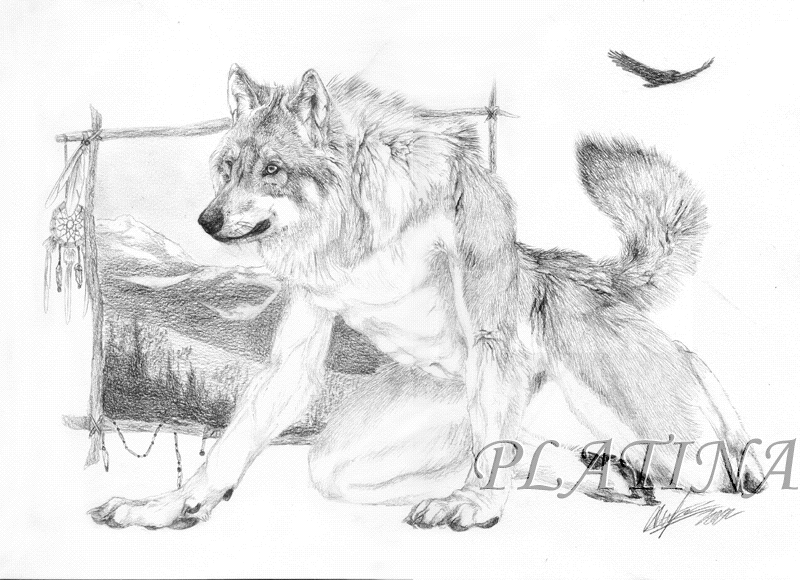
I'll start from the artwork of Ailah (aka Platina), the artist who always comes first to my mind when I think of Yerf even though her art is not very representative of what was found on the site.


My favorite works by Ailah are dated about 2002-2003, at the peak of the relatively short lived but influential were community. Few traces of that community are left nowadays even though the most popular artists it fostered such as Goldenwolf and Kyoht still have a loyal following and have set the golden standard for all the following werewolf art. (Actually "skin-changer art" would be a more correct assessment of their place relative to prior art... but that's a topic for another time.)


Ailah's works were indeed exceptional by the standards of the furry community of the time. The blending of human and canine traits in this image is so inspired it still gives me the chills after so many years. The pose is distinctively feral, the canine way of expressing attention with gaze, ears and tail frozen in time like only a person deeply in love with wolves could do. Most were artists used to exaggerate the size and shape of prehensile paws to the point of caricature, but here they are fairly believable. The fur's texture is made more prominent where it most contributes to define a lupine silhouette: neck, shoulders, back and tail. You can tell that the artist would love to meet this creature in real life and have him pose for her. The corny background ruins the effect a bit, which is probably why the artist pulled this drawing from all online archives, but it is also a feat of sincerity since Native American clichés inspired the were community quite a lot.


Here the pose is still feral and similar to that of a resting wolf, but the simplicity of the picture, the lighting, the entranced expression and the prominent blind eye embed the portrait with a solemnity similar to that of a sphinx. The disheveled hair only adds to both the liveliness and mysterious vibe. The forepaws are slim and graceful, hinting at intellect and possibly tension between the human and the animal natures of the werewolf. Here is a wise creature who may give good advice.


While the landscapes in these works may appear somewhat stereotypical they always struck me as full of love and restrained passion. It's probably the combination of muted colors and simple but effective compositions.


Another iconic image, closer to typical fantasy this time, but rest assured you won't find anything like this in current mainstream stuff except for comedy effect. It's simply a rogue wolf with her horse. There's no need to say much more than this really: no person with a functional imagination can remain indifferent in front of such a cue.


These last two images are revealing of Ailah's taste for less-than-obvious details. With such a start it's not surprising that she went on to become a professional illustrator. Her main style has evolved away from furry realism and towards a more mainstream cartoony approach, but it's still full of personality and she still pays uncommon attention to the characteristic visual features of each species. And her love for werewolves still surfaces with all the passion and charm of the early days when given the chance.

Links:
Ailah's art at the Yerf Archive